

How Compost Tea Works, The Biology Behind the Brew
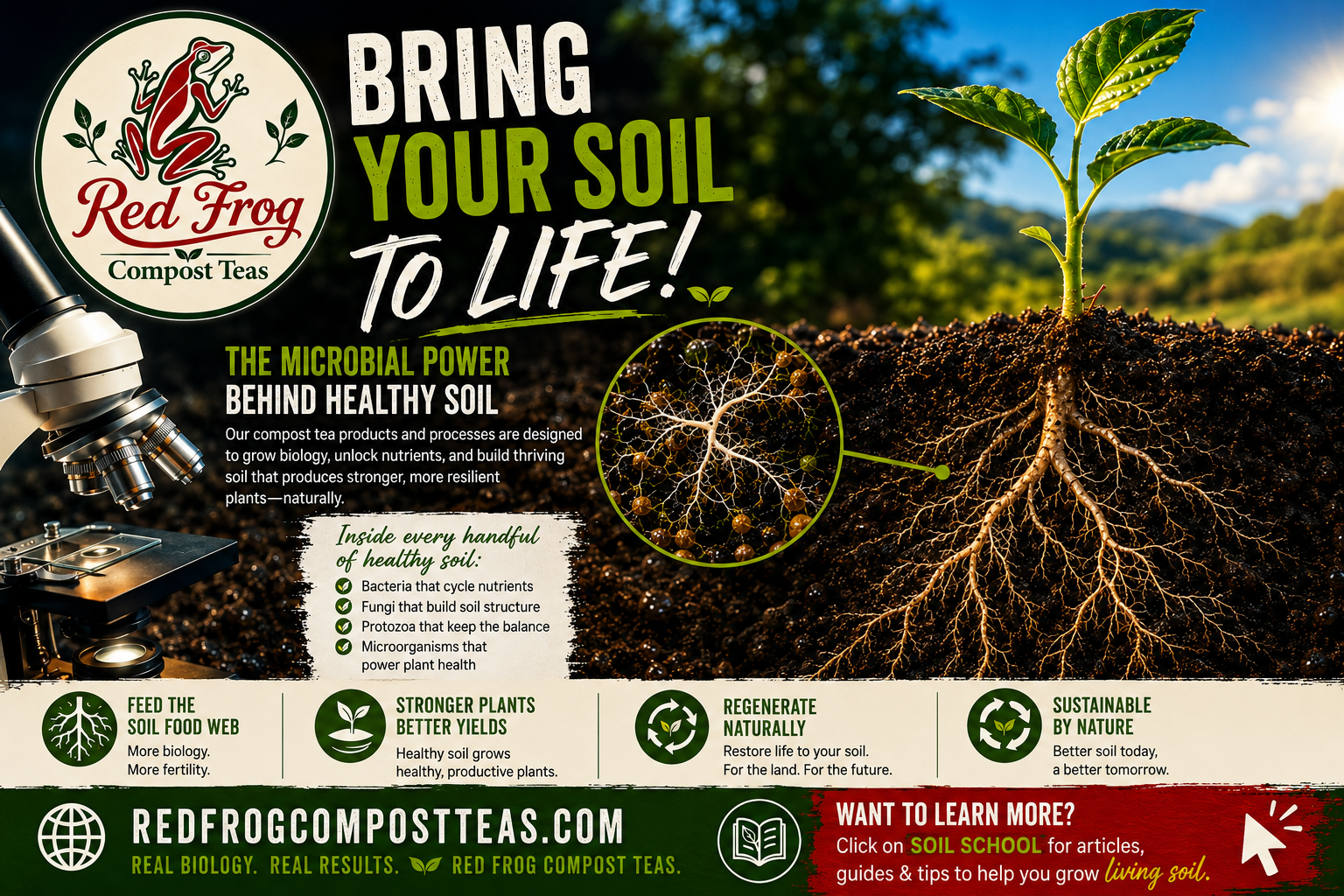
We're not trying to make fertilizer in a bucket. We're growing biology.
Most people think brewing compost tea starts when you turn on the air pump. It doesn't. A good compost tea starts long before the water is ever involved, and understanding that changes everything about how you approach the process.
The Foundation Is the Compost
Everything depends on the quality and biological activity of what goes into the brewer. We use worm castings along with a fungal-rich compost or humus as the biological base, and from there we add a carefully selected mixture of plant meals, marine ingredients, and mineral-rich rock powders. But we don't simply mix those ingredients together, put them in a bag, and call it compost tea. That's where most people stop, and it's where most compost teas fall short.
Biological Conditioning — The Step Most People Skip
The dry amendments are blended into the compost and then moistened with water or actively aerated compost tea to begin another biological cycle. The mixture is allowed to re-compost while being regularly turned to maintain oxygen and control temperature. During this time, bacteria and fungi begin breaking down the organic ingredients and interacting with the minerals throughout the mixture, and this step matters more than most people realize. Many nutrients can be present in an ingredient without being immediately available to either microorganisms or plants. Biological decomposition begins converting those materials into forms that can actually move through the soil food web. You are not just combining ingredients — you are beginning a biological process that makes those ingredients more effective before a single drop of water is added.
Completing the Blend
After this biological conditioning process, we complete the blend with more readily available ingredients — hydrolyzed fish, kelp, sea minerals, and humic and fulvic substances. Humic acids, and especially the smaller fulvic compounds, can interact with minerals and help keep certain nutrients mobile and accessible within the biological system. They are not just fertilizer ingredients. They are part of the biological infrastructure that allows the whole system to function, and the result is not simply compost plus microbial food. It is an already active biological substrate designed to come alive quickly when placed into properly aerated water.
What Happens When You Brew
When you add this material to clean, dechlorinated water and begin pumping oxygen through it, you are giving an existing microbial community the conditions it needs to multiply. Bacteria reproduce rapidly, fungal hyphae continue developing throughout the organic material, and protozoa and other organisms follow. With adequate aeration maintained throughout the brewing period, the goal is to produce a diverse, living biological community — not to extract soluble fertilizer from compost. That is an important distinction and it is where most commercial compost teas and home brews fall short. Compost extract — made by simply soaking compost in water without aeration — pulls out some soluble nutrients and a fraction of the microbial population, but it is not the same thing as what we are describing here. Actively aerated compost tea, brewed from a properly conditioned biological substrate with adequate oxygen, food sources, and time, produces something fundamentally different.
The Goal
We are not trying to make fertilizer in a bucket. We are growing biology. When that biology is applied to your soil it does not just deliver nutrients — it delivers living organisms that integrate into the soil food web, support root systems, cycle nutrients continuously, and help build the kind of soil that grows healthier plants season after season. That is what separates a well-made compost tea from everything else on the shelf.
Everything starts in the soil.
