

A Simple Recipe for High-Quality Compost Tea: Ingredients, Quality, and Why They Matter
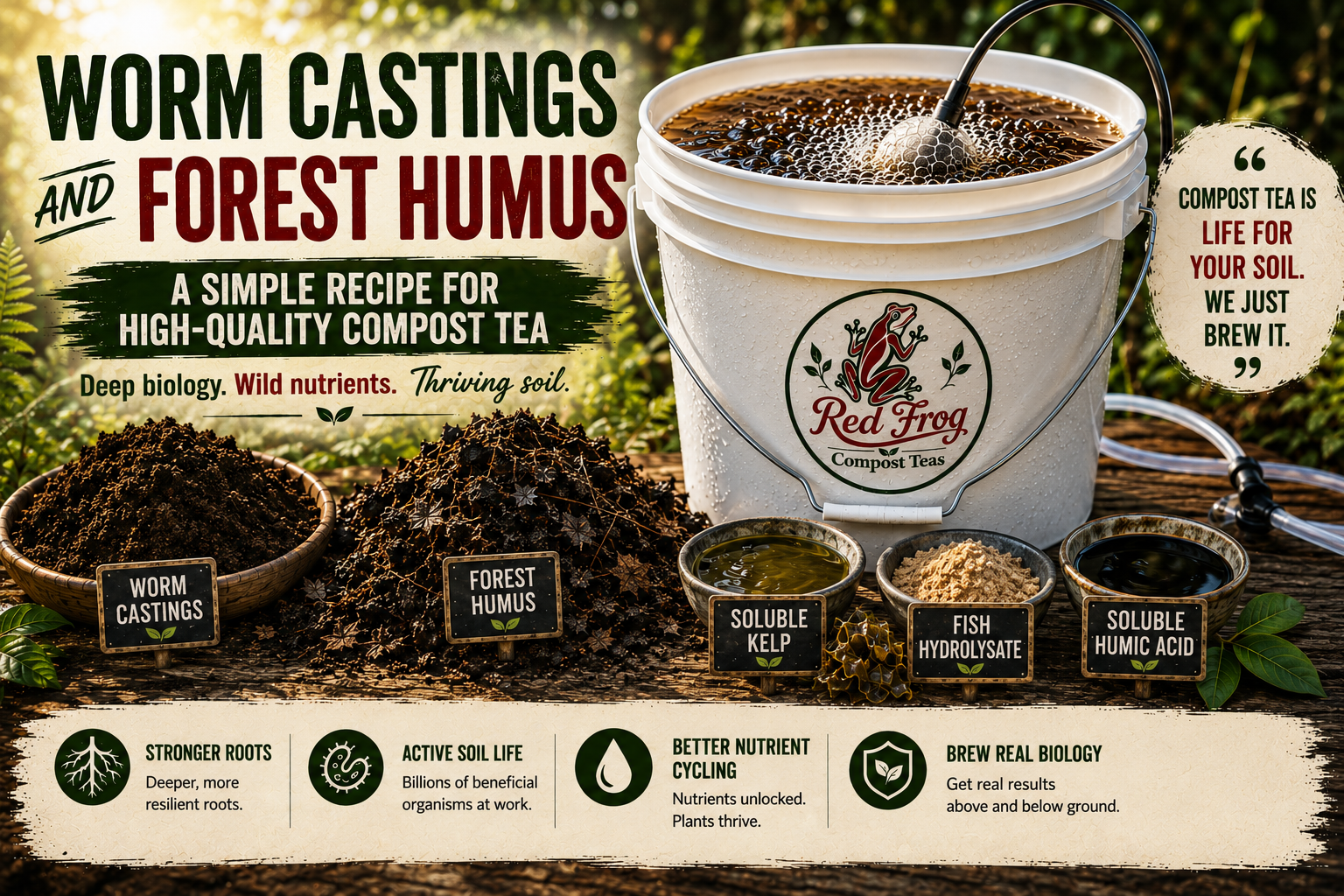
This is a basic recipe, but don't let that fool you because, built correctly with quality ingredients, it will produce an actively aerated compost tea with greater biological activity and diversity than most recipes you'll find online. Most people assume compost tea starts with a bag of compost from the garden center, but it doesn't, and what goes into the brewer sets the foundation for everything that comes out of it. The organisms you start with, the diversity of that community, and the nutritional complexity available to your soil all trace back to the quality and composition of what you started with, and this is where many commercial compost teas and home brews fall short.
The Base Blend
The foundation of a quality compost tea begins not with a single ingredient but with a carefully assembled blend, and the quality of each component determines the diversity and biological activity of everything that follows. The first and most important component is quality worm castings, which bring a dense microbial population along with plant-available nutrients, beneficial compounds, and a biological profile that's difficult to replicate with any other single ingredient, though not all worm castings are equal and understanding what separates a high-quality source from a mediocre one matters more than most growers realize.
The key is feedstock diversity, because worms raised on a varied mixture of plant-based organic matter, decomposing vegetation, carbon-rich materials, grains, meals, and appropriate mineral sources are exposed to a much broader range of materials than worms raised primarily on a single feedstock, and that matters because we're not choosing worm castings simply for their nutrient analysis but for the biology they bring into the brewer. The feedstock, how it was managed, and the conditions under which it decomposed all influence the finished vermicompost, so when selecting castings for compost tea it's worth finding out how they were actually produced rather than judging them simply by appearance or the numbers printed on the bag. Castings produced primarily from composted animal waste are a good example of why that distinction matters because they can be extremely biologically active, but that activity tends to be heavily dominated by bacteria, and while that doesn't make them poor castings, biological activity and biological diversity are not the same thing, and for compost tea we're interested in both. A broader range of feedstocks gives us a broader biological starting point, while other components of the base blend are deliberately included to introduce organisms that worm castings generally don't provide in significant numbers.
That brings us to fungi, because while worm castings are frequently described as containing both bacterial and fungal biology, in practice they tend to be strongly bacterial since worms and the conditions within an active vermicomposting system favor bacterial decomposition, meaning even excellent castings may contribute relatively little established fungal biomass to the brew. That's exactly why the second component of the blend matters as much as the first, and that component is forest humus, which develops through years of relatively undisturbed decomposition and supports fungal networks and microbial communities very different from those typically found in a worm bin or heavily cultivated soil. Forest humus provides a source of fungal biology that complements the bacterial strength of the castings, and that balance matters because fungal diversity is something many growers are missing and many compost teas fail to deliver, since starting with an overwhelmingly bacterial inoculum and then feeding it doesn't somehow create fungal diversity that wasn't there to begin with, which means that if you want a biologically broader tea you have to start with a biologically broader inoculum. All materials are screened before blending to remove large, insufficiently decomposed pieces, which creates a more consistent base material and helps ensure the biologically active fraction is distributed throughout the blend rather than leaving unfinished chunks mixed into an otherwise conditioned product.
The Recipe
The recipe itself is intentionally simple because the goal isn't to see how many ingredients we can put into a brewer, but to begin with quality biology, provide that biology with a range of appropriate foods and compounds, and maintain enough oxygen to support a rapidly expanding aerobic microbial population throughout the brewing period. This recipe is built around a 5-gallon brewer and can be scaled proportionally for larger systems.
For a 5-gallon brew:
5 gallons of water
1 cup high-quality worm castings
1 cup forest humus, quality matters here and it should not be dried out
1 teaspoon hydrolyzed fish powder
1 teaspoon soluble kelp
1 teaspoon soluble humic acid
An air pump rated at approximately 650 to 1,000 gallons per hour
One large diffuser or air stone capable of distributing that airflow throughout the brewer
If you're using chlorinated municipal water, start the air pump and aerate the water by itself for 30 to 60 minutes before adding the castings, forest humus, or brewing additives. This allows the chlorine to dissipate before the biology is introduced while also giving you a well-aerated starting point for the brew.
Under good brewing conditions, this recipe will produce a biologically active tea within about 24 hours and generally doesn't need to go beyond 48. If you are brewing toward the longer end of that range and looking to encourage more fungal development, you can add an additional teaspoon of each additive at the 24-hour mark rather than front-loading everything at the start. Forest humus is the primary source of fungal biology in this recipe, so the quality and moisture of what you source matters more than the quantity, because dried-out or low-quality humus will not deliver the fungal diversity that makes this recipe work.
The air supply is every bit as important as the ingredients, because once the biology begins multiplying, its demand for oxygen increases with it, and a small aquarium pump producing a few visible bubbles at the surface isn't the same thing as maintaining an aggressively aerated environment throughout the entire water column. A 650 to 1,000 gallon-per-hour air pump paired with a large diffuser or air stone creates the circulation and oxygen transfer necessary to keep the brew aerobic as microbial populations increase, which is critical because the objective isn't simply to make bubbles but to maintain an environment capable of supporting the biology we're trying to grow.
Brewing Additives
Once the base blend goes into the brewer, a second group of carefully selected ingredients goes in with it, each serving a different role in supporting the biological community that will multiply throughout the brewing period, with some providing readily available microbial foods and others influencing the chemical environment in which those microorganisms are multiplying. Hydrolyzed fish powder provides a broad food source of peptides, amino acids, lipids, minerals, and other marine-derived organic compounds that bacteria respond to strongly and that fungi can also utilize, making it more than a nitrogen source since a quality low-temperature hydrolysate delivers a range of compounds that support a diverse biological community throughout the brewing period rather than simply driving a fast bacterial bloom. Soluble kelp contributes carbohydrates, minerals, and a range of organic compounds that complement the fish rather than duplicate it, and where hydrolyzed fish is primarily protein and lipid derived, kelp brings a different nutritional profile that creates additional nutritional niches for different organisms to exploit, so providing multiple chemically different food sources supports a broader biological community than relying on any single input.
Soluble humic acid plays a different role from the other additives, functioning not primarily as a microbial food but as an influence on the chemistry of the brewing environment, and when dispersed through the water column during brewing, humic compounds can interact with mineral ions and help keep certain nutrients mobile and accessible within the biological system. Quality soluble humic products often contain a meaningful fulvic fraction as well, and because fulvic compounds remain soluble across a wider range of conditions, they can interact throughout the entire brew, making both humic and fulvic compounds part of the environment in which the biology is growing rather than simply another food source.
A Note on Molasses
Molasses is one of the most commonly recommended compost tea additives and one of the most misunderstood, because while the idea is simple, add sugar, feed the microbes, and get more biology, the problem is that molasses acts like steroids for soil microbiology, driving a large, rapid bloom of biomass regardless of whether those organisms are beneficial or not, giving you numbers but not necessarily diversity or quality. Because molasses is a simple sugar rather than a complex food source, that population can crash once the readily available food source is gone, which is why a well-made compost tea doesn't need a sugar spike but instead needs diverse, complex food sources capable of supporting a broader range of organisms throughout the entire brewing period, and that's the reason for using hydrolyzed proteins, kelp, and humic compounds rather than trying to create the biggest possible microbial bloom with a simple sugar.
What This Adds Up To
There isn't one magic ingredient responsible for a quality compost tea because it's the system that matters. The worm castings provide a strong bacterial foundation, the forest humus broadens that foundation with fungal biology and organisms associated with a very different decomposition environment, and the brewing additives provide different foods, minerals, and compounds that allow that community to multiply without deliberately pushing one group to dominate simply because it can consume a simple sugar faster than everything else. The goal isn't to produce the highest possible organism count in 24 hours but to grow a diverse, living biological community and introduce it to the soil in a condition where it can continue to function, and while the recipe itself is simple, the quality and diversity of what goes into it are what make the difference between a tea that performs and one that simply checks a box. The result isn't fertilizer and it isn't simply a nutrient solution; it's a living biological inoculant, and every ingredient is there for a reason.
Everything starts in the soil.
